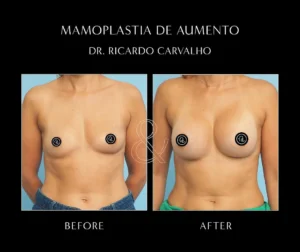
Breast augmentation RC3210332


Description of the case before and after
BREAST AUGMENTATION TO TREAT POST-PREGNANCY BREAST ATROPHY
The decrease in breast size (breast atrophy) after pregnancy is very common. As well as causing negative physical changes to a woman's body, it causes equally significant emotional changes, with undeniable damage to her self-esteem.
A breast augmentation is the surgery that allows you to restore breast volume and re-establish the harmony that the body lost during pregnancy and breastfeeding. This surgery is performed under general anaesthetic and with specific nerve blocks, so that the patient wakes up pain-free and can move her arms immediately after surgery.
This surgery used round, high-projection, 410cc silicone prostheses, but with a weight 30% less than their volume, because they are lighter than most. These lighter prostheses place less weight on the tissues and so the breast will fall at a slower rate. In addition to the lighter prostheses, a surgical technique has been used that helps to "hold" the prosthesis; in this technique, the prostheses are placed partially behind the muscle (pectoralis major) and part of this muscle makes an internal strap (also called an "internal bra"), which supports the prosthesis. With the combination of these prostheses and this technique, the breast will fall at a slower rate. This technique also makes it possible to accentuate the neckline, without the edges of the implant being visible. The breast looks natural.
The scar is on the underside of the areola and will continue to improve in appearance over the months. All patients must wear a post-surgical bra for one month and apply a healing cream. The images show the result one month after surgery.
To appreciate the result, it's important to look at the patient's biometric data. This patient is approximately 1.69 metres tall and weighs 60kg. We can see the result one year after surgery.
Note: The images shown on this page are real examples of treatments carried out by Dr Ricardo CarvalhoThese are published with the prior, free and informed consent of the users involved, respecting the rules on the protection of personal data and the right to an image.
It is important to note that results may vary from person to person, depending on individual conditions and the clinical assessment carried out. These images are not a guarantee of similar results in other cases.
The decision to carry out any treatment should be made after a personalised medical consultation and assessment, ensuring that the procedure is suited to your specific needs and conditions.