Breast augmentation RC2220001


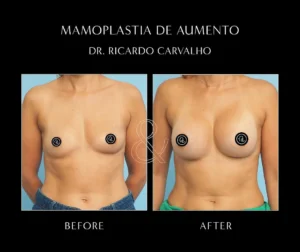
Description of the case before and after
BREAST AUGMENTATION
Sometimes the breast doesn't develop as much as a woman would like. This condition, called breast hypoplasia, can have consequences for a woman's self-esteem, her personal relationships and can also create difficulties in simpler but equally important things, such as choosing clothes.
A Breast augmentation is the surgery that allows you to increase the size of the breast and its projection, improve the neckline and the proportion between the chest and the rest of the body. This surgery is performed under general anaesthesia. In addition to general anaesthesia, we perform specific anaesthesia techniques so that patients wake up pain-free, speeding up their post-operative recovery.
Post-operatively, we recommend wearing a post-operative bra, carrying out manual lymphatic drainage and applying specific creams to improve the appearance of the scars.
In this case, round, high-profile, nano-textured prostheses with 355cc were used. The prostheses were placed through the breast crease. The subfascial technique was used. The images show the result one month after surgery.
The result will change over time. In fact, there is never a "final result" because the appearance of the breasts will always change over time. In the first few months, these changes are more noticeable.
About six months after the surgery, the changes start to become smaller and more gradual; but over the years there will be subtle and gradual changes.
Note: The images shown on this page are real examples of treatments carried out by Dr Ricardo CarvalhoThese are published with the prior, free and informed consent of the users involved, respecting the rules on the protection of personal data and the right to an image.
It is important to note that results may vary from person to person, depending on individual conditions and the clinical assessment carried out. These images are not a guarantee of similar results in other cases.
The decision to carry out any treatment should be made after a personalised medical consultation and assessment, ensuring that the procedure is suited to your specific needs and conditions.